Why Hybrid Mesh Firewalls Are Emerging as a New Approach to Enterprise Network Security
Sep 30, 2026
Enterprise networks are no longer confined to a single data center or a clearly defined corporate perimeter.
Organizations may have physical data centers, branch offices, virtualized workloads, public cloud environments, remote users and increasingly distributed applications. Firewalls have followed that expansion, often resulting in multiple products, deployment models and management consoles operating across the same enterprise.
That creates a different problem from simply having enough firewall capacity.
It creates a network security management problem.
Gartner's research on hybrid mesh firewalls reflects this shift. Its 2024 Market Guide for Hybrid Mesh Firewall Platforms identified the growing complexity of implementing and managing firewalls across multiple use cases. In September 2026, Gartner published both a Magic Quadrant for Hybrid Mesh Firewall and Critical Capabilities for Hybrid Mesh Firewall, highlighting centralized management across physical, virtual and cloud-native deployments.
For enterprises managing increasingly distributed infrastructure, hybrid mesh firewall architecture is becoming an important model to evaluate.
What Is a Hybrid Mesh Firewall?
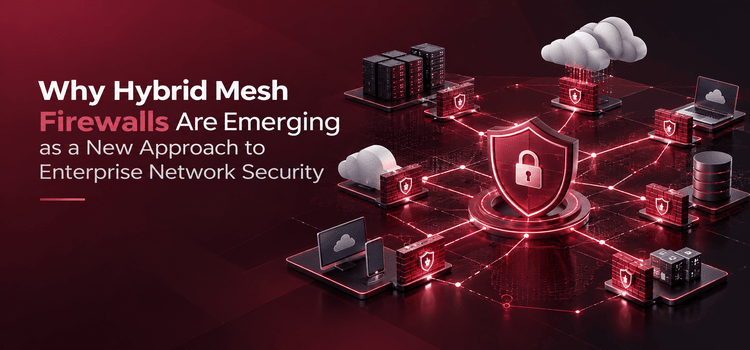
A hybrid mesh firewall is designed to bring different firewall deployment types under a unified management approach.
In practical terms, an enterprise might have:
A physical firewall protecting a data center
Virtual firewalls protecting workloads
Cloud-based firewall enforcement in public cloud environments
Firewall controls supporting branch locations
Secure remote-access controls
Different security policies across these environments
Instead of managing each deployment independently, a hybrid mesh approach aims to provide centralized visibility, policy management and orchestration.
The word "mesh" is important because the model is not about deploying one firewall at one location. It is about connecting multiple enforcement points across a distributed enterprise environment while maintaining a common management and security framework.
Why Firewall Management Is Becoming More Complex
Firewall sprawl often happens gradually.
A company may start with a traditional data-center firewall. Later, it adds cloud workloads. A branch office requires another deployment model. A merger introduces another firewall platform. Remote access requirements add further controls.
Over time, the security architecture can become a collection of products that were each reasonable when purchased but are difficult to manage collectively.
This can create several operational challenges.
Different Security Policies
Policies configured independently across different environments can drift over time.
One environment may have a stricter rule than another, while administrators may have limited visibility into why the differences exist.
Multiple Management Consoles
Security teams may need to switch between separate interfaces to investigate traffic, modify policies or review security events.
That adds operational overhead and can make troubleshooting more difficult.
Limited Visibility Across Environments
A security team needs to understand how traffic and policies operate across on-premises, cloud and distributed environments.
Fragmented tooling can make that picture harder to establish.
Increasing Operational Complexity
Managing different firewall products, deployment models and policies can increase the amount of administrative work required from security and infrastructure teams.
The challenge, therefore, is not simply firewall performance.
It is how the entire firewall estate is operated.
What Changes With a Hybrid Mesh Approach?
The central idea is consolidation of management rather than necessarily consolidation of every physical security control.
An enterprise can continue using different enforcement points according to its requirements while managing them through a more unified framework.
Centralized Management
A common management plane can provide a single location for policy administration, monitoring and reporting across different deployment types.
This can help security teams establish more consistent operational processes across the firewall estate.
More Consistent Security Policies
Centralized policy management can help organizations reduce unnecessary differences between environments and establish more consistent security controls.
This does not automatically make policies correct. Governance and policy design still remain important.
Better Visibility
A distributed firewall estate becomes easier to understand when security teams can view policies, enforcement points and events through a common management framework.
That can support faster investigation and more consistent operational processes.
Cloud and CI/CD Integration
Modern applications increasingly depend on cloud infrastructure and automated deployment pipelines.
Hybrid mesh firewall platforms can support integration with cloud environments and application development processes, allowing security controls to operate alongside increasingly automated infrastructure.
This matters when network security controls need to keep pace with application and infrastructure changes.
Support for Distributed Environments
Hybrid mesh firewall platforms are intended to address environments spanning data centers, branches, hybrid networks and multicloud deployments.
This makes the approach particularly relevant to enterprises whose infrastructure is distributed across multiple environments.
Does Every Enterprise Need a Hybrid Mesh Firewall?
No.
The existence of a new technology category does not automatically mean an organization should replace its current firewall architecture.
A hybrid mesh approach becomes more relevant when an organization is dealing with several of the problems it is designed to address:
Multiple firewall deployment types
Hybrid or multicloud infrastructure
Distributed branch environments
Policy inconsistency
Multiple management platforms
Increasing firewall administration overhead
Need for centralized visibility
Integration between network security and cloud or application operations
For a smaller environment with a straightforward network architecture, the operational benefits may not justify a major migration.
That is why the decision should begin with the organization's existing architecture rather than the technology category itself.
The Business Case for Consolidating Firewall Management
Firewall architecture is often treated as a purely technical decision.
In large enterprises, it also affects operational cost, administration, governance and risk.
A more unified management model can potentially reduce duplicated administrative processes and make it easier for teams to establish common security practices.
But consolidation introduces its own trade-offs.
Moving multiple environments toward a common platform can increase dependence on one technology ecosystem. Migration can also involve:
Policy conversion
Application compatibility testing
Network redesign
Licensing changes
Integration work
Training
Operational transition
There can also be environments where an existing firewall cannot simply be replaced because of technical, regulatory or operational requirements.
Centralization can simplify management, but it does not eliminate architecture decisions.
What Enterprises Should Evaluate Before Migrating
Organizations considering hybrid mesh firewall platforms should begin with an inventory of their current environment.
1. Map the Firewall Estate
Identify:
Physical firewalls
Virtual appliances
Cloud firewalls
Branch deployments
Remote-access infrastructure
Management platforms
Security integrations
The objective is to understand what exists before deciding what should change.
2. Identify Policy Inconsistencies
Look for environments where similar applications or workloads are protected by substantially different policies.
These differences may be intentional, but they should be understood.
3. Evaluate Deployment Requirements
Assess whether the organization needs:
Data-center protection
Branch security
Multicloud support
Secure remote access
Cloud-native integration
CI/CD integration
Advanced threat prevention
Centralized reporting
The technology should be evaluated against actual enterprise requirements rather than the feature list alone.
4. Plan Migration in Phases
Replacing every firewall simultaneously can introduce unnecessary operational risk.
A phased approach allows organizations to test policy migration, integrations and application behaviour before expanding the deployment.
5. Consider Vendor Concentration
Consolidation can simplify operations, but it can also increase dependence on a single vendor.
Organizations should therefore evaluate:
Contractual commitments
Licensing changes
Exit costs
Migration complexity
Integration dependencies
Support requirements
Long-term architecture flexibility
The goal should be simplification without creating a new form of dependency.
Hybrid Mesh Firewall Is an Architecture Decision, Not a Checkbox
The emergence of hybrid mesh firewall research reflects a broader change in enterprise infrastructure.
Security controls increasingly have to operate across physical infrastructure, virtual environments and cloud platforms.
The challenge is no longer simply deploying another firewall.
It is creating a security architecture that can be managed consistently across the environments where the business actually operates.
For organizations experiencing firewall sprawl, inconsistent policies or fragmented management, hybrid mesh firewall platforms provide an architecture worth evaluating.
But migration should be driven by the organization's existing environment, operational requirements and security objectives, not by the category label or a vendor roadmap alone.
The right question is not whether every enterprise should adopt a hybrid mesh firewall.
It is whether the organization's current firewall architecture is still practical to manage as its infrastructure becomes more distributed.
Proztec Perspective
Firewall sprawl rarely happens through one major architectural decision. It usually accumulates as infrastructure evolves.
A new branch adds another firewall. A cloud migration introduces another deployment model. A new application requires another security control. Over time, the organization may end up with a network security environment that is technically capable but increasingly difficult to operate consistently.
Hybrid mesh firewall architecture offers one way to approach that complexity by bringing different enforcement environments under a more unified management model.
For enterprises evaluating it, the starting point should be visibility, policy consistency and operational requirements.
The technology should follow the architecture need, not the other way around.
 Phone : +974 44420050

 Doha, Qatar







 Celebrating Excellence: Mr. Syed Rizwan ...